FAO Internship Programme 2026: Global Paid Internship Guide for Students and Recent Graduates

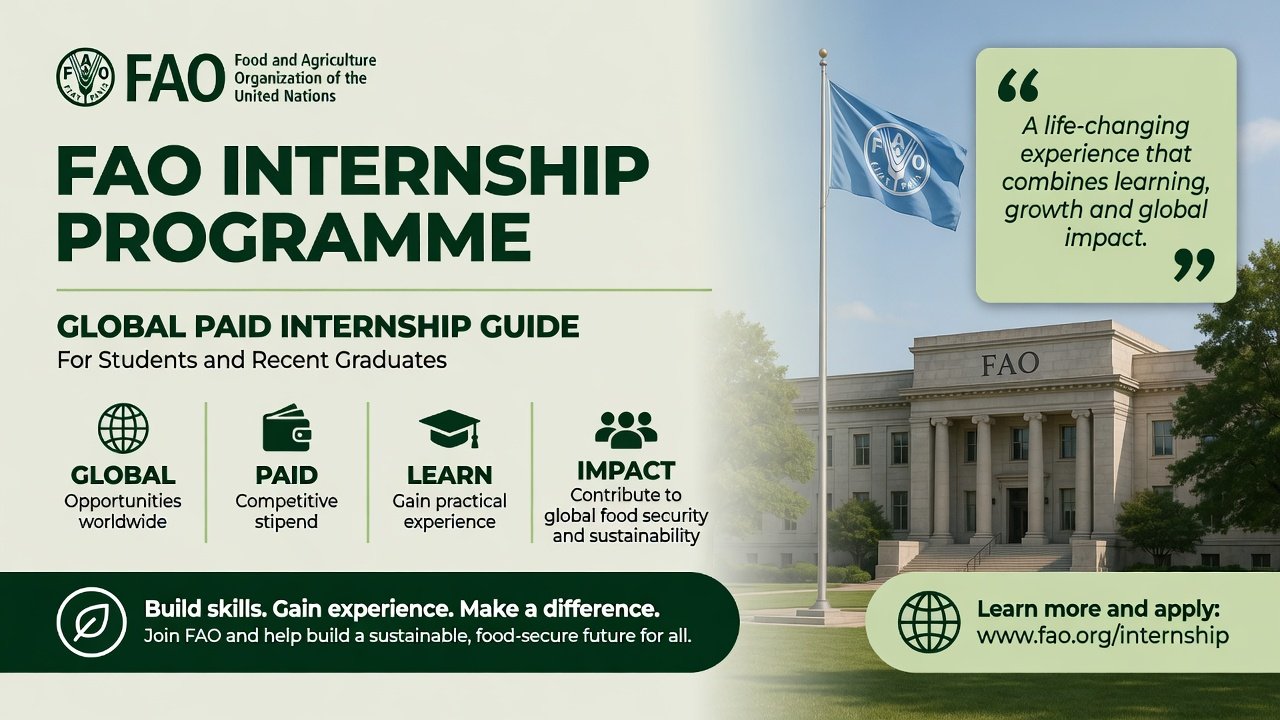
Building an international career often starts with gaining practical experience at a respected global organization. For students and recent graduates interested in agriculture, food security, climate action, environmental sustainability, nutrition, fisheries, forestry, economics, or international development, the Food and Agriculture Organization of the United Nations (FAO) Internship Programme offers an excellent opportunity to develop professional skills while contributing to projects that support the UN Sustainable Development Goals.
The FAO Internship Programme 2026 is designed to provide talented young people with hands-on experience in FAO’s worldwide operations. Interns work alongside experienced professionals, contribute to ongoing projects, and gain exposure to international policymaking and technical cooperation. Opportunities are available at FAO Headquarters in Rome as well as regional, sub-regional, and country offices across the globe. The programme is open to eligible students and recent graduates from FAO Member Nations.
Opportunity Overview
| Category | Details |
|---|---|
| Organization | Food and Agriculture Organization of the United Nations (FAO) |
| Programme | Internship Programme 2026 |
| Locations | FAO Headquarters (Rome) and Worldwide Country & Regional Offices |
| Work Arrangement | On-site, Hybrid, or Remote (depending on assignment) |
| Programme Type | Paid Internship |
| Duration | 3 to 11 Months |
| Eligible Applicants | Students and Recent Graduates from FAO Member Nations |
| Application Method | Online through the FAO Careers Portal |
About the Food and Agriculture Organization (FAO)
The Food and Agriculture Organization is the United Nations agency leading international efforts to eliminate hunger, improve nutrition, reduce poverty, and promote sustainable agricultural development. Since its establishment in 1945, FAO has partnered with governments, research institutions, farmers, and development organizations to strengthen food systems and improve livelihoods worldwide.
Its work spans agriculture, fisheries, forestry, animal health, food safety, climate resilience, rural development, emergency response, and natural resource management. Through its internship programme, FAO provides young professionals with the opportunity to contribute to these global priorities while learning from experienced international experts.
Why the FAO Internship Programme Is Highly Competitive
Global Learning Environment
Interns gain experience within one of the world’s leading international organizations working on food security and sustainable development.
Exposure to International Projects
Assignments often involve supporting technical teams, policy initiatives, research activities, and development programmes that benefit countries around the world.
Career Development
The programme allows participants to build practical experience, strengthen professional networks, and better understand careers within the United Nations system.
Contribution to Sustainable Development
Interns support projects aligned with the Sustainable Development Goals, particularly those related to ending hunger, protecting natural resources, and promoting resilient food systems.
Areas of Work
Internship assignments vary depending on organizational needs and an applicant’s academic background. Opportunities may be available in areas such as:
- Agriculture
- Food Security
- Nutrition
- Forestry
- Fisheries and Aquaculture
- Climate Change
- Environmental Management
- Veterinary Science
- Economics
- Statistics and Data Analysis
- Communications
- Information Technology
- Human Resources
- Finance
- Programme Management
- International Relations
- Rural Development
- Monitoring and Evaluation
Key Responsibilities
Responsibilities differ by department but may include:
- Conducting research and background analysis for technical projects.
- Assisting with reports, presentations, and policy documents.
- Supporting programme implementation and project coordination.
- Collecting, organizing, and analysing data.
- Assisting with communication materials and publications.
- Participating in meetings, workshops, and technical discussions.
- Supporting administrative and operational activities.
- Collaborating with multicultural teams across different FAO offices.
- Contributing ideas that support innovation and organizational goals.
Qualifications & Eligibility
Applicants should carefully review the official internship announcement before applying.
Education
Applicants must be:
- Enrolled in an undergraduate or postgraduate degree programme at the time of application, or
- Recent graduates from a recognized educational institution.
Nationality
Candidates must be nationals of an FAO Member Nation.
Age Requirement
Applicants should generally be between 21 and 30 years old when the internship begins.
Technical Skills
Successful candidates typically demonstrate:
- Strong analytical abilities
- Research skills
- Microsoft Office proficiency
- Good organizational skills
- Basic data analysis capabilities
- Ability to work independently and collaboratively
Communication Skills
FAO values candidates who can:
- Communicate clearly in writing and verbally.
- Work effectively in multicultural environments.
- Adapt to international workplaces.
- Manage multiple tasks efficiently.
Language Requirements
Applicants should have a working knowledge of at least one FAO official language (Arabic, Chinese, English, French, Russian, or Spanish). Knowledge of a second FAO language is considered an advantage.
Financial Support & Programme Conditions
The FAO Internship Programme provides selected interns with a monthly stipend of up to US$700, subject to applicable conditions and funding arrangements. Internship assignments generally last between three and eleven months. Interns are responsible for arranging accommodation and non-service-related medical insurance, while FAO provides service-incurred medical coverage.
Benefits of the Internship
Practical International Experience
Interns gain hands-on experience within a United Nations specialized agency working on global development challenges.
Professional Mentorship
Participants work under the guidance of experienced professionals and technical specialists.
Global Networking
The programme offers opportunities to connect with colleagues and experts from different countries and disciplines.
Skill Development
Interns strengthen research, communication, project management, and analytical skills in a professional environment.
Strong Career Foundation
Experience at FAO can enhance future applications for graduate programmes, international organizations, NGOs, research institutions, and public-sector careers.
Step-by-Step Application Guide
1. Review Current Internship Calls
Visit the FAO Careers Portal and identify the appropriate Call for Expression of Interest for your preferred office or region.
2. Prepare Your CV
Include:
- Academic qualifications
- Research experience
- Relevant coursework
- Volunteer activities
- Technical skills
- Language proficiency
- Publications or projects (if applicable)
3. Write a Strong Motivation Letter
Explain:
- Why you want to join FAO.
- Your career goals.
- How your studies relate to FAO’s mission.
- The area of work that interests you most.
4. Gather Supporting Documents
Prepare:
- Proof of university enrolment or graduation
- Updated CV
- Motivation letter
- Any additional documents requested in the vacancy
5. Submit Your Online Application
Complete the online application through the official FAO recruitment portal before the published closing date. Only shortlisted candidates are contacted for further assessment.
Common Mistakes Applicants Make
Many candidates reduce their chances by making avoidable errors, including:
- Submitting a generic motivation letter.
- Failing to explain how their academic background aligns with FAO’s work.
- Uploading incomplete documentation.
- Ignoring language requirements.
- Waiting until the application deadline to apply.
- Applying without carefully reading the eligibility criteria.
Related Career Opportunities
If you’re interested in the FAO Internship Programme, you may also consider:
- FAO Volunteer Programme
- FAO Young Professionals Programme
- United Nations Development Programme (UNDP) Internships
These programmes offer valuable international experience for students and graduates pursuing careers in development, sustainability, and global policy.
Frequently Asked Questions
Is the FAO Internship Programme paid?
Yes. Eligible interns may receive a monthly stipend of up to US$700, subject to FAO’s programme conditions.
Who can apply?
Students enrolled in undergraduate or postgraduate programmes, as well as recent graduates who meet the eligibility criteria, may apply. Applicants must also be nationals of an FAO Member Nation.
How long does the internship last?
Internship assignments generally range from 3 to 11 months, depending on the position and organizational needs.
Do I need previous work experience?
Previous professional experience is not usually required. However, relevant academic projects, research, volunteer work, or internships can strengthen your application.
Where can I apply?
Applications should be submitted through the official FAO Careers Portal under the relevant Call for Expression of Interest. FAO Careers Portal
Final Thoughts
The FAO Internship Programme 2026 is an outstanding opportunity for students and recent graduates who want to begin an international career in agriculture, food security, environmental sustainability, and global development. With assignments lasting up to eleven months, a monthly stipend, and opportunities to work alongside experienced professionals, the programme provides practical experience that can strengthen both technical knowledge and future career prospects.
A successful application starts with meeting the eligibility requirements, preparing a tailored CV and motivation letter, and demonstrating a genuine interest in FAO’s mission. By applying through the official recruitment portal and presenting a well-prepared application, aspiring professionals can take an important first step toward a rewarding career within the United Nations system.