FAO Fellows Programme 2026: Fully Explained Global Research Fellowship Opportunity at the United Nations

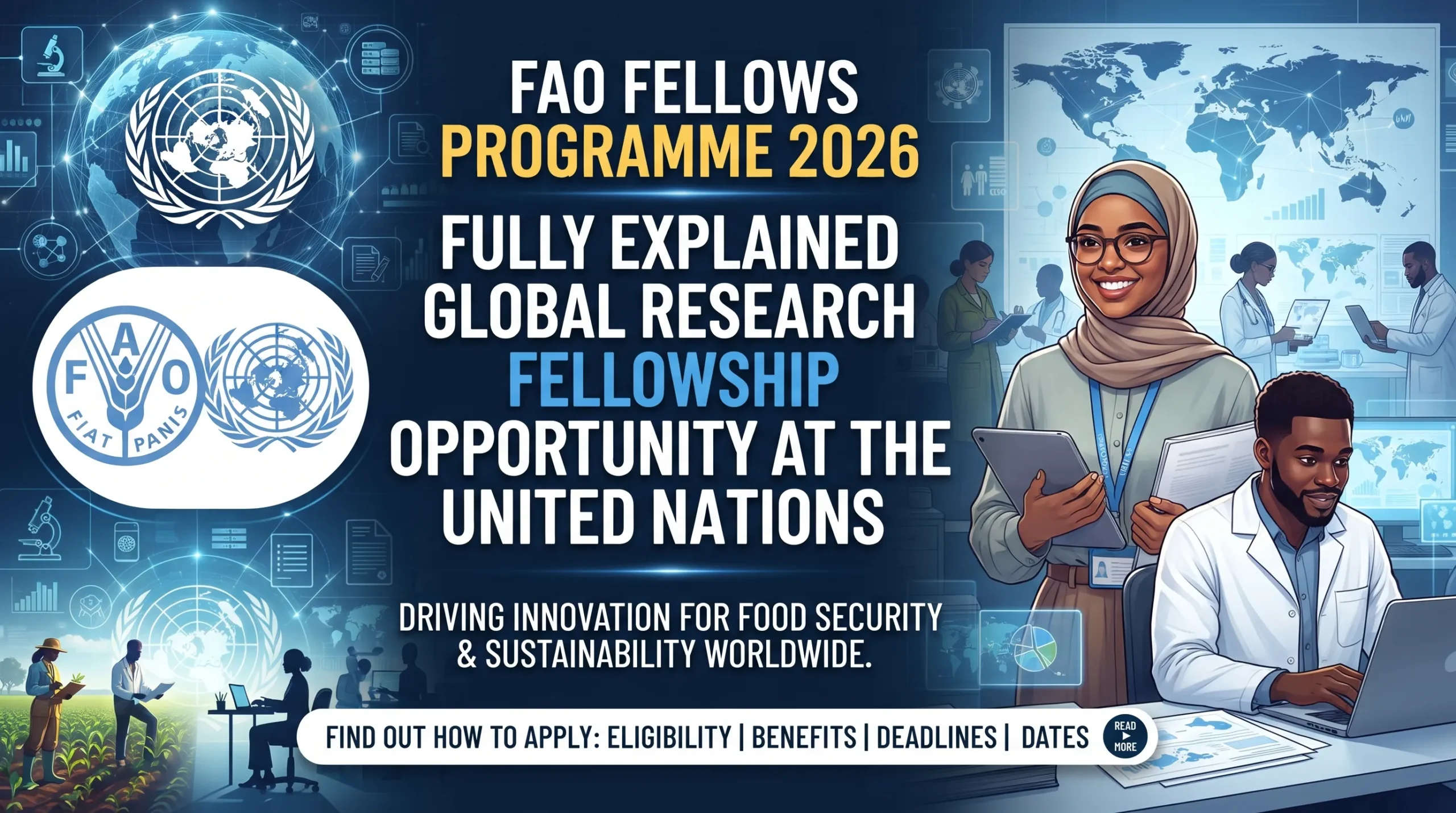
The FAO Fellows Programme 2026 is a prestigious opportunity offered by the Food and Agriculture Organization (FAO) of the United Nations for highly qualified researchers, academics, and professionals who wish to contribute their expertise to global food security, sustainable agriculture, rural development, fisheries, forestry, nutrition, and environmental sustainability.
The programme is designed to attract talented individuals from FAO Member countries who can support the organization’s mission while expanding their professional knowledge in an international and multicultural environment. Fellows work alongside experienced specialists, researchers, and policymakers, gaining valuable exposure to global development initiatives and evidence-based policy making.
Unlike traditional employment opportunities, the FAO Fellows Programme focuses on knowledge exchange and professional development. Fellows contribute their specialized expertise to FAO projects while strengthening their research skills, international networks, and understanding of global agricultural and food systems.
The fellowship can last up to 11 months, depending on organizational needs and the approved work plan. Although the programme does not generally provide a salary, it offers an exceptional opportunity to collaborate with one of the world’s leading international organizations dedicated to ending hunger, improving nutrition, and promoting sustainable agriculture. Applicants are typically expected to have external financial support to cover their participation.
Whether you are an experienced researcher, a PhD candidate, or a professional seeking international exposure, the FAO Fellows Programme 2026 can significantly strengthen your academic profile and open doors to future opportunities within international organizations.
Fellowship Overview
| Fellowship Name | FAO Fellows Programme 2026 |
|---|---|
| Organization | Food and Agriculture Organization (FAO) |
| Host Organization | United Nations (UN) |
| Programme Type | International Fellowship |
| Duration | Up to 11 Months |
| Location | FAO Headquarters or Country/Regional Offices |
| Eligible Countries | FAO Member Countries |
| Education Required | Master’s Degree, PhD, or Current PhD Enrollment |
| Experience | Minimum Two Years of Relevant Experience |
| Financial Support | External Sponsorship Generally Required |
| Application Mode | Online |
| Application Fee | None |
About the Food and Agriculture Organization (FAO)
The Food and Agriculture Organization (FAO) is a specialized agency of the United Nations established in 1945 with the mission of achieving food security for all. FAO works with governments, international organizations, research institutions, civil society, and the private sector to reduce hunger, improve agricultural productivity, promote sustainable natural resource management, and support rural development.
Today, FAO operates in more than 130 countries, addressing some of the world’s most pressing challenges, including:
- Food security
- Sustainable agriculture
- Climate change adaptation
- Fisheries and aquaculture
- Forestry conservation
- Animal health
- Plant protection
- Nutrition
- Rural livelihoods
- Emergency and humanitarian response
Through research, technical assistance, policy advice, and capacity-building initiatives, FAO helps countries develop resilient food systems that support long-term economic and environmental sustainability.
Why the FAO Fellows Programme Is Prestigious
The FAO Fellows Programme is highly respected because it offers participants the opportunity to work within a United Nations agency that plays a leading role in global food and agriculture policy.
Gain United Nations Experience
Fellows collaborate with international experts, technical officers, economists, scientists, and policymakers working on projects that have a real-world impact across multiple regions.
This experience enhances professional credibility and demonstrates the ability to work in a multicultural and international environment.
Work on Global Challenges
Participants contribute to initiatives addressing issues such as:
- Global food insecurity
- Climate-resilient agriculture
- Sustainable farming practices
- Water resource management
- Biodiversity conservation
- Rural poverty reduction
- Nutrition improvement
- Agricultural innovation
This allows fellows to apply their knowledge to projects with meaningful global significance.
Build an International Professional Network
The programme offers valuable opportunities to establish relationships with:
- FAO technical experts
- UN professionals
- Government representatives
- International researchers
- Development partners
- Academic institutions
These connections can lead to future research collaborations and career opportunities.
Develop Specialized Expertise
Working alongside experienced professionals allows fellows to deepen their understanding of international development, agricultural policy, food systems, environmental sustainability, and research methodologies.
Enhance Future Career Opportunities
Participation in an FAO fellowship demonstrates strong academic and professional capability and can strengthen applications for:
- United Nations careers
- International NGOs
- Research institutions
- Government agencies
- Universities
- International development organizations
Fellowship Benefits
Although the FAO Fellows Programme is generally not a salaried position, it provides numerous academic and professional benefits.
International Professional Experience
Participants gain hands-on experience working within a United Nations organization recognized worldwide for its technical expertise.
Research Collaboration
Fellows work with internationally recognized specialists in agriculture, food security, economics, environmental science, nutrition, and related disciplines.
Professional Development
The programme helps participants strengthen:
- Research skills
- Policy analysis
- Technical expertise
- Project management
- International communication
- Cross-cultural collaboration
Exposure to Global Projects
Depending on their assignment, fellows may contribute to projects involving:
- Sustainable agriculture
- Climate resilience
- Agricultural innovation
- Rural development
- Food systems transformation
- Natural resource management
- Emergency food assistance
Networking Opportunities
Participants have the opportunity to engage with:
- FAO experts
- UN agencies
- Academic researchers
- Government officials
- International organizations
- Development partners
Building these relationships can support future academic and professional growth.
Areas of Research and Technical Fields
The FAO Fellows Programme welcomes applicants from a wide range of disciplines aligned with FAO’s mission.
Examples include:
- Agriculture
- Agronomy
- Animal Science
- Veterinary Medicine
- Fisheries
- Forestry
- Environmental Science
- Climate Change
- Food Science
- Nutrition
- Agricultural Economics
- Rural Development
- Water Resource Management
- Natural Resource Management
- Biodiversity
- Soil Science
- Plant Science
- Biotechnology
- Statistics
- Data Science
- Economics
- Public Policy
- International Development
- Geographic Information Systems (GIS)
Applicants whose expertise aligns with FAO’s technical priorities are encouraged to apply.
Eligibility Requirements
To be considered for the FAO Fellows Programme 2026, applicants should generally meet the following requirements.
Nationality
Applicants must be nationals of an FAO Member country.
Educational Qualifications
Applicants should possess one of the following:
- Master’s degree
- Doctoral (PhD) degree
- Current enrollment in a PhD programme
The qualification should be relevant to FAO’s technical areas of work.
Professional Experience
Candidates are generally expected to have at least two years of relevant professional or research experience in their field of specialization.
Relevant experience may include:
- Academic research
- Government service
- NGO projects
- International development
- Agricultural research
- Environmental management
- Policy analysis
Language Requirements
Applicants should have a working knowledge of at least one FAO official language, such as:
- English
- French
- Spanish
- Arabic
- Chinese
- Russian
Knowledge of additional FAO official languages may be an advantage.
Personal Competencies
Successful applicants should demonstrate:
- Strong analytical skills
- Research capability
- Teamwork
- Communication skills
- Professional integrity
- Adaptability
- Commitment to international development
- Ability to work in multicultural environments
Required Documents
Preparing a complete and well-organized application is one of the most important steps in the FAO Fellows Programme selection process. Before applying, carefully review the vacancy announcement to ensure you meet all eligibility requirements and have the necessary documents ready.
Applicants are generally expected to provide the following:
Updated Curriculum Vitae (CV)
Your CV should clearly present your:
- Educational background
- Professional experience
- Research activities
- Technical expertise
- Publications (if applicable)
- Conferences and workshops
- Professional certifications
- Language proficiency
Keep your CV professional, well-structured, and free from unnecessary information.
Cover Letter
A strong cover letter should explain:
- Why you want to join the FAO Fellows Programme
- Your research or professional interests
- Relevant technical expertise
- How your background aligns with FAO’s mission
- Your career goals
Personalize your letter instead of using a generic template.
Educational Certificates
Applicants should be prepared to provide copies of:
- Master’s degree
- PhD degree
- Proof of current PhD enrollment (if applicable)
- Academic transcripts (if requested)
Research Proposal or Statement of Interest
Depending on the assignment, applicants may be asked to submit a research proposal or statement describing:
- Research interests
- Technical specialization
- Proposed contribution
- Expected outcomes
- Areas of collaboration with FAO
A clear and realistic proposal can strengthen your application.
Language Information
Applicants may need to indicate their proficiency in one or more FAO official languages.
Include any recognized language qualifications if available.
Additional Supporting Documents
Some opportunities may also request:
- List of publications
- Professional references
- Portfolio of technical work
- Employment certificates
- Identification document
Always check the specific vacancy announcement for the latest requirements.
How to Apply
The FAO Fellows Programme uses an online recruitment process. Following each step carefully can improve your chances of submitting a complete application.
Step 1: Review the Programme Announcement
Carefully read the fellowship description before applying.
Pay attention to:
- Eligibility criteria
- Required qualifications
- Technical field
- Fellowship duration
- Required documents
- Application deadline
Step 2: Prepare Your Application Materials
Before starting the online application, prepare:
- Updated CV
- Cover letter
- Educational documents
- Supporting materials
- Research information
Having all documents ready helps avoid mistakes during submission.
Step 3: Complete the Online Application
Applicants should accurately enter:
- Personal details
- Educational history
- Employment experience
- Technical expertise
- Language skills
Ensure all information matches your supporting documents.
Step 4: Upload Supporting Documents
Attach all requested files in the required format.
Before submitting:
- Check spelling and grammar.
- Verify dates.
- Ensure documents are complete.
- Review the application for accuracy.
Step 5: Submit Before the Deadline
Applications submitted after the published deadline may not be considered.
Early submission is recommended to avoid technical issues.
Selection Process
The FAO recruitment team reviews applications according to the programme requirements.
Selection typically considers:
Academic Qualifications
Applicants should demonstrate strong educational achievements relevant to the fellowship.
Technical Expertise
Experience should match FAO’s areas of work, such as:
- Agriculture
- Food systems
- Nutrition
- Forestry
- Fisheries
- Climate change
- Rural development
- Environmental sustainability
Professional Experience
The committee evaluates the relevance and quality of previous work experience.
Research projects, publications, and field experience may strengthen an application.
Motivation
Applicants should clearly explain:
- Why they want to join FAO
- Their career objectives
- Their expected contribution to the programme
Communication Skills
Strong written communication is important because fellows often prepare reports, research papers, technical documents, and presentations.
Fellowship Responsibilities
Although assignments vary by department, fellows generally support technical and research activities.
Typical responsibilities include:
Conduct Research
Assist with research projects related to FAO’s technical priorities.
Data Analysis
Collect, organize, analyze, and interpret technical information to support projects and policy development.
Prepare Reports
Contribute to:
- Technical reports
- Research papers
- Policy briefs
- Background studies
- Presentations
Support International Projects
Work with multidisciplinary teams supporting agricultural and rural development initiatives around the world.
Participate in Meetings
Attend:
- Technical workshops
- Conferences
- Team meetings
- Knowledge-sharing sessions
- International seminars
Collaborate with Experts
Work alongside specialists from diverse technical backgrounds while contributing your own expertise.
Working Environment at FAO
FAO promotes an inclusive, collaborative, and multicultural workplace where professionals from around the world work together to address global food and agriculture challenges.
Fellows can expect to work in an environment that values:
- Diversity
- Inclusion
- Scientific integrity
- Innovation
- Collaboration
- Respect
- Professional development
Assignments may be based at:
- FAO Headquarters
- Regional Offices
- Country Offices
- Liaison Offices
- Technical Divisions
Depending on organizational needs and the fellowship assignment.
Tips to Strengthen Your Application
Competition for FAO fellowships is often high. These strategies can help improve your application.
Tailor Your Application
Customize your CV and cover letter to highlight experience relevant to the specific technical area.
Demonstrate Research Experience
Include examples of:
- Research projects
- Publications
- Conference presentations
- Technical reports
- Fieldwork
- International collaboration
Highlight Technical Skills
Showcase expertise in areas such as:
- Statistical analysis
- GIS
- Data management
- Agricultural research
- Climate science
- Policy analysis
Relevant software skills can also strengthen your application.
Explain Your Motivation
Clearly describe why you wish to contribute to FAO’s mission of achieving food security and sustainable agriculture.
A genuine motivation statement often leaves a stronger impression.
Proofread Carefully
Before submitting:
- Check grammar.
- Correct spelling errors.
- Verify document formatting.
- Confirm all attachments are included.
A polished application reflects professionalism and attention to detail.
Career Opportunities After the Fellowship
Completing the FAO Fellows Programme can strengthen your professional profile and open doors to future opportunities.
Possible career paths include:
- FAO Consultant
- FAO Technical Specialist
- Research Scientist
- Agricultural Policy Analyst
- Environmental Specialist
- Rural Development Expert
- Nutrition Programme Officer
- International Development Consultant
- University Researcher
- Government Agricultural Advisor
Many former fellows also pursue careers with other United Nations agencies, international NGOs, research institutions, and development organizations.
The experience gained through the fellowship can enhance your expertise, expand your global network, and support future applications for research grants, international projects, and leadership roles in the agriculture and development sectors.
Frequently Asked Questions (FAQs)
1. What is the FAO Fellows Programme 2026?
The FAO Fellows Programme is an international fellowship offered by the Food and Agriculture Organization (FAO) of the United Nations. It provides researchers and professionals with the opportunity to contribute to FAO’s technical work while gaining valuable international experience in agriculture, food security, nutrition, and sustainable development.
2. Who can apply for the FAO Fellows Programme?
Applicants must generally:
- Be nationals of an FAO Member country.
- Hold a Master’s degree, PhD, or be currently enrolled in a PhD programme.
- Have at least two years of relevant professional or research experience.
- Demonstrate working knowledge of at least one FAO official language.
Applicants must also meet any additional requirements specified in the fellowship announcement.
3. Is the FAO Fellows Programme fully funded?
No. The programme generally does not provide a salary or living allowance. Fellows are usually expected to have financial support from their university, employer, government, scholarship provider, or another sponsoring organization. Applicants should carefully review the official fellowship announcement for the latest funding details.
4. How long does the fellowship last?
The fellowship may last up to 11 months, depending on the approved work plan and organizational requirements.
5. Where are fellows placed?
Fellows may be assigned to:
- FAO Headquarters in Rome, Italy
- Regional Offices
- Subregional Offices
- Country Offices
- Liaison Offices
Placement depends on the technical assignment and organizational needs.
6. What fields of study are eligible?
Applicants from many disciplines are encouraged to apply, including:
- Agriculture
- Environmental Science
- Forestry
- Fisheries
- Food Science
- Nutrition
- Economics
- Climate Change
- Rural Development
- Veterinary Medicine
- Natural Resource Management
- Public Policy
- Statistics
- Data Science
7. Is previous United Nations experience required?
No. Previous UN experience is not normally required. However, relevant academic, research, or professional experience related to FAO’s areas of work can strengthen an application.
8. What language skills are required?
Applicants should have a working knowledge of at least one FAO official language:
- English
- French
- Spanish
- Arabic
- Chinese
- Russian
Knowledge of additional official languages may be an advantage.
9. Can early-career researchers apply?
Yes. Early-career researchers who meet the educational and experience requirements are encouraged to apply. Applicants should demonstrate how their expertise and proposed contribution align with FAO’s technical priorities.
10. How can I improve my chances of selection?
To strengthen your application:
- Tailor your CV and cover letter.
- Highlight relevant research and technical experience.
- Clearly explain your motivation for joining FAO.
- Demonstrate how your expertise supports FAO’s mission.
- Submit a complete and well-organized application before the deadline.
Final Thoughts
The FAO Fellows Programme 2026 offers an exceptional opportunity for researchers, academics, and professionals to collaborate with one of the world’s leading United Nations organizations dedicated to eliminating hunger, improving nutrition, and promoting sustainable agriculture.
Although the fellowship is generally not a salaried programme, its value lies in the international experience, exposure to global development initiatives, access to experienced technical experts, and opportunities to contribute to projects with real-world impact. Participants can strengthen their research capabilities, expand their professional networks, and gain insights into international policymaking and technical cooperation.
Because the programme is highly competitive, applicants should invest time in preparing a strong application that highlights their academic achievements, professional experience, technical expertise, and commitment to FAO’s mission. A well-written statement of interest and carefully prepared supporting documents can make a meaningful difference during the selection process.
If your career goals include working on global food security, sustainable agriculture, climate resilience, nutrition, or rural development, the FAO Fellows Programme 2026 is an excellent opportunity to enhance your expertise while contributing to solutions that benefit communities worldwide.