University of Melbourne Visiting Fellowship 2026: Fully Funded Research Fellowship in Australia with Up to AUD $6,000 Support

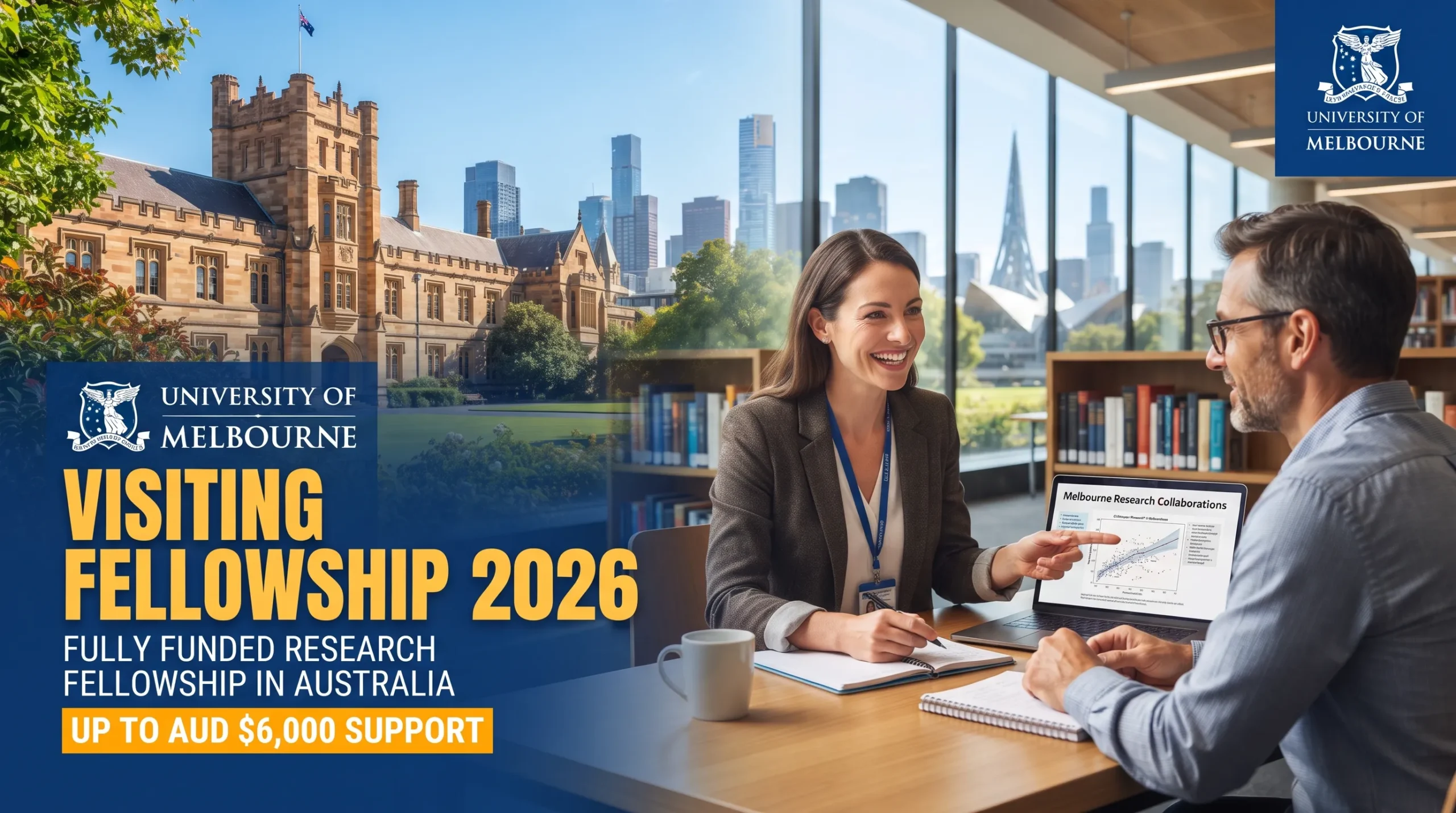
The University of Melbourne Visiting Fellowship 2026 is an outstanding opportunity for researchers, academics, practitioners, and educators who are passionate about advancing research on statelessness. Hosted by the Peter McMullin Centre on Statelessness at Melbourne Law School, this prestigious fellowship allows participants to collaborate with leading experts while conducting research in one of Australia’s highest-ranked universities.
The fellowship is designed to strengthen international research collaboration and support innovative work that contributes to a better understanding of statelessness and citizenship issues worldwide. Successful applicants will spend up to two months at the University of Melbourne, participating in seminars, workshops, and collaborative research activities.
One funded fellowship is available for the 2026 cycle, providing up to AUD $6,000 to help cover international travel and accommodation costs in Melbourne. In addition to financial support, fellows receive access to office space, library resources, computing facilities, and an internationally respected academic community.
Whether you are an early-career researcher, an experienced academic, or a practitioner working on issues related to nationality and statelessness, this fellowship offers an excellent platform to expand your research, develop international collaborations, and contribute to meaningful global policy discussions.
Fellowship Overview
| Fellowship Name | University of Melbourne Visiting Fellowship 2026 |
|---|---|
| Host Country | Australia |
| Host Institution | University of Melbourne – Melbourne Law School |
| Centre | Peter McMullin Centre on Statelessness |
| Fellowship Type | Visiting Research Fellowship |
| Funding | Up to AUD $6,000 |
| Duration | Up to 2 Months |
| Fellowship Period | July – November 2026 |
| Eligible Applicants | International Researchers, Academics, Practitioners & Educators |
| Application Deadline | 30 November 2025 |
| Application Fee | None |
About the University of Melbourne
Founded in 1853, the University of Melbourne is consistently ranked among Australia’s leading universities and is recognized internationally for excellence in research, teaching, and innovation.
Melbourne Law School is particularly respected for its contributions to international law, human rights, public policy, and legal research. The Peter McMullin Centre on Statelessness has become one of the world’s leading academic centers dedicated to studying statelessness and developing practical policy solutions through research, education, and global collaboration.
The Centre works with universities, governments, international organizations, civil society groups, and legal practitioners to improve understanding of statelessness and promote evidence-based solutions.
Why This Fellowship Is Prestigious
The University of Melbourne Visiting Fellowship is highly competitive because it combines financial support with access to one of the world’s most respected research environments.
Conduct Research at a World-Class University
Fellows become part of an internationally recognized academic community and gain access to experienced researchers specializing in nationality law, migration, refugee protection, and human rights.
Build International Research Networks
The fellowship encourages collaboration with scholars from different countries and disciplines, helping participants establish long-term professional relationships.
Present Your Research
During the fellowship, participants are expected to present their work through seminars or work-in-progress sessions, providing valuable opportunities for academic feedback and discussion.
Access Outstanding Research Resources
Fellows receive:
- Dedicated workspace
- University library access
- Computer facilities
- Academic support
- Opportunities to participate in Centre activities
These resources create an ideal environment for focused research and professional development.
Enhance Academic Recognition
Being selected for a University of Melbourne Visiting Fellowship can strengthen an academic CV and demonstrate international research experience, benefiting future grant applications and career opportunities.
Fellowship Benefits
The funded Visiting Fellowship offers financial and academic support to help researchers focus on their projects.
Financial Support
Selected fellows may receive funding of up to AUD $6,000, which can be used to support:
- International airfare
- Accommodation in Melbourne
- Travel-related expenses associated with the fellowship
The exact amount requested should be justified in the application budget and cannot exceed the funding limit.
Academic Benefits
Participants receive access to:
- Personal workspace
- University library
- Computer facilities
- Academic seminars
- Research workshops
- Faculty presentations
- Professional networking opportunities
Professional Development
The fellowship enables participants to:
- Collaborate with internationally recognized experts
- Receive feedback on research
- Develop new research partnerships
- Expand international academic networks
- Increase publication opportunities
Career Advantages
Completing a Visiting Fellowship at the University of Melbourne can strengthen future applications for:
- Research grants
- Academic promotions
- International fellowships
- Postdoctoral positions
- University faculty appointments
- Policy research organizations
Research Focus Areas
The fellowship specifically supports research connected to statelessness and related issues.
Potential research themes include:
- Statelessness law
- Citizenship and nationality
- Human rights
- Refugee protection
- Forced displacement
- Migration law
- International law
- Public policy
- Identity documentation
- Gender and nationality laws
- Childhood statelessness
- Legal identity
- Comparative citizenship systems
- Humanitarian protection
Applicants from different academic disciplines are encouraged to propose innovative research that contributes to the Centre’s mission.
Eligibility Requirements
The fellowship welcomes applications from a broad range of professionals working in areas related to statelessness.
Eligible applicants include:
Academics
Applications are encouraged from:
- Early-career researchers
- Postdoctoral researchers
- Assistant Professors
- Associate Professors
- Professors
- Independent scholars
Practitioners
Professionals working in areas such as:
- Human rights
- International organizations
- Government agencies
- Legal practice
- Refugee services
- Public policy
may also apply if they propose an applied research project relevant to the Centre’s work.
Educators
Teachers and university educators conducting research related to nationality, migration, citizenship, or statelessness are eligible.
Researchers with Lived Experience
The Centre strongly encourages applications from researchers with lived experience of statelessness, recognizing the value of diverse perspectives in advancing research and policy.
Basic Eligibility Criteria
Applicants should generally:
- Have a strong research interest in statelessness.
- Propose a research project aligned with the Centre’s objectives.
- Be available to undertake the fellowship between July and November 2026.
- Demonstrate the potential to contribute to the Centre’s research activities.
- Be willing to participate in seminars, workshops, and collaborative events during the fellowship.
Required Documents
Preparing a complete and well-organized application is one of the most important steps toward securing the University of Melbourne Visiting Fellowship. Incomplete applications or missing supporting documents may not be considered during the selection process.
Applicants are generally expected to submit the following documents:
Completed Application Form
Fill out the official fellowship application form carefully, ensuring all sections are complete and accurate.
Curriculum Vitae (CV)
Your CV should clearly highlight:
- Educational qualifications
- Academic positions
- Research experience
- Publications
- Conference presentations
- Awards and scholarships
- Professional memberships
- Relevant work experience
A concise academic CV of 2–4 pages is usually appropriate unless the application instructions state otherwise.
Research Proposal
The research proposal is the most important part of your application.
A strong proposal should explain:
- Research title
- Research objectives
- Background of the study
- Research questions
- Methodology
- Expected outcomes
- Timeline
- How the fellowship will contribute to your research
Applicants should also explain why conducting the research at the Peter McMullin Centre on Statelessness will strengthen their project.
Budget Proposal
Applicants requesting financial support should include an estimated budget covering eligible expenses such as:
- International airfare
- Accommodation
- Local transportation
- Other approved travel-related costs
Funding requests should not exceed AUD $6,000.
Supporting Documents
Depending on the application requirements, additional documents may include:
- List of publications
- Letters of recommendation
- Writing samples
- Proof of current employment
- Academic transcripts
- Passport identification page
Always review the official application guidelines before submission.
Application Process
Applying for the University of Melbourne Visiting Fellowship is straightforward, but careful preparation is essential.
Step 1: Review the Fellowship Guidelines
Before preparing your application, carefully read the official fellowship announcement.
Pay close attention to:
- Eligibility requirements
- Research focus
- Fellowship duration
- Required documents
- Funding conditions
- Application deadline
Understanding the selection criteria will help you prepare a stronger application.
Step 2: Develop Your Research Proposal
Your proposal should demonstrate:
- Originality
- Academic relevance
- Clear objectives
- Practical significance
- Alignment with the Centre’s research priorities
Applicants who clearly explain how their research contributes to the study of statelessness generally have stronger applications.
Step 3: Prepare Supporting Documents
Ensure every document is:
- Up to date
- Professionally formatted
- Free of spelling errors
- Submitted in the required format
Consistency across all application materials creates a positive impression.
Step 4: Submit Your Application
Applications should be submitted before the published deadline.
Late submissions are generally not accepted unless specifically permitted by the fellowship organizers.
After submission, applicants should keep copies of all documents for future reference.
Step 5: Selection Process
Applications are reviewed by the fellowship selection committee.
The committee evaluates:
- Academic quality
- Research proposal
- Relevance to statelessness
- Potential contribution to the Centre
- Applicant’s professional achievements
- Overall suitability for the fellowship
Because the fellowship is highly competitive, only the strongest candidates are shortlisted.
Step 6: Notification
Successful applicants are contacted after the evaluation process.
Selected fellows receive information regarding:
- Fellowship dates
- Funding arrangements
- Travel planning
- Administrative requirements
- Research schedule
Selection Criteria
Applications are assessed on several important factors.
Academic Excellence
Applicants should demonstrate a strong academic or professional background relevant to the proposed research.
Research Quality
Selection committees look for research proposals that are:
- Well structured
- Innovative
- Clearly written
- Academically rigorous
- Feasible within the fellowship period
Relevance to Statelessness
Projects should contribute meaningfully to research on:
- Statelessness
- Citizenship
- Nationality law
- Human rights
- Migration
- Refugee protection
The closer the proposal aligns with the Centre’s mission, the stronger the application is likely to be.
Potential Impact
Applicants should explain how their research may contribute to:
- Academic knowledge
- Public policy
- Legal reform
- International cooperation
- Practical solutions for stateless communities
Collaboration
The committee also considers how applicants will engage with:
- Faculty members
- Researchers
- Students
- Academic seminars
- Centre activities
Active participation is an important part of the fellowship experience.
Fellowship Expectations
During the fellowship, participants are expected to contribute actively to the Centre’s academic community.
Typical expectations include:
- Conduct independent research.
- Participate in seminars.
- Attend workshops.
- Collaborate with Centre researchers.
- Share research findings.
- Deliver at least one research presentation or seminar.
- Produce research outputs during or after the fellowship.
The fellowship is designed to encourage knowledge exchange rather than simply providing financial support.
Research Environment
The Peter McMullin Centre on Statelessness offers a supportive and collaborative environment for researchers from around the world.
Fellows benefit from:
World-Class Faculty
Researchers work alongside internationally recognized experts in:
- Human rights law
- Nationality law
- Refugee law
- International law
- Public policy
Excellent Library Resources
The University of Melbourne provides access to:
- Extensive legal databases
- Academic journals
- Research books
- Digital archives
- Online research tools
Collaborative Community
Fellows interact with:
- Visiting scholars
- PhD researchers
- Faculty members
- International experts
- Policy practitioners
These interactions often lead to future research collaborations and publications.
Tips to Strengthen Your Application
Competition for the fellowship is intense. The following strategies can improve your chances of success.
Choose a Strong Research Topic
Focus on an important issue that contributes new knowledge to the study of statelessness.
Demonstrate Originality
Explain how your research differs from existing studies and why it is important.
Align with the Centre’s Mission
Clearly connect your proposal to the Centre’s research priorities and ongoing work.
Present a Realistic Timeline
Show that your project can be completed, or significantly advanced, during the fellowship period.
Highlight Previous Achievements
Include:
- Publications
- Research grants
- Conference presentations
- Awards
- Professional experience
These achievements demonstrate your ability to complete high-quality research.
Write Clearly
Selection committees appreciate applications that are:
- Well organized
- Concise
- Professional
- Easy to understand
Avoid unnecessary technical language where possible.
Proofread Carefully
Small mistakes can weaken an otherwise strong application.
Before submitting:
- Check spelling.
- Verify dates.
- Review references.
- Confirm document formatting.
Living in Melbourne During the Fellowship
Melbourne is widely recognized as one of Australia’s leading academic and cultural cities.
Visiting fellows can enjoy:
- Excellent public transportation
- Safe neighborhoods
- International research community
- Modern libraries
- Museums and cultural attractions
- Diverse dining options
- Parks and recreational spaces
The city’s multicultural environment makes it welcoming for international researchers from around the world.
Frequently Asked Questions (FAQs)
1. What is the University of Melbourne Visiting Fellowship 2026?
The University of Melbourne Visiting Fellowship 2026 is a funded research opportunity hosted by the Peter McMullin Centre on Statelessness at Melbourne Law School. It supports researchers, academics, practitioners, and educators conducting research related to statelessness and nationality.
2. Is the fellowship fully funded?
The fellowship provides financial support of up to AUD $6,000 to help cover eligible travel and accommodation expenses during the fellowship. Applicants should review the official guidelines to understand what costs are covered and any expenses they may need to fund themselves.
3. Who can apply?
Eligible applicants include:
- Researchers
- Academics
- Postdoctoral scholars
- Practitioners
- Educators
- Independent researchers
Applicants should have a research proposal that aligns with the Centre’s focus on statelessness and related topics.
4. How long is the fellowship?
The fellowship can be undertaken for up to two months, with visits generally scheduled between July and November 2026.
5. What research topics are supported?
The Centre welcomes projects related to:
- Statelessness
- Citizenship
- Nationality law
- Human rights
- Refugee protection
- Forced displacement
- Migration
- International law
- Public policy
- Identity documentation
- Gender and nationality
Interdisciplinary proposals are also encouraged where they contribute to understanding statelessness.
6. Do I need to be an Australian citizen?
No. The fellowship welcomes international applicants as well as eligible researchers based in Australia, provided they meet the program requirements.
7. What documents are required?
Applicants are typically asked to submit:
- Completed application form
- Curriculum Vitae (CV)
- Research proposal
- Budget outlining expected expenses
- Supporting documents specified in the official call
Always check the latest application instructions before submitting.
8. Is English language proficiency required?
Applicants should have sufficient English proficiency to conduct research, participate in seminars, and communicate effectively with faculty members and other researchers.
9. Can early-career researchers apply?
Yes. Early-career researchers are encouraged to apply if they have a strong research proposal and can demonstrate how the fellowship will contribute to their academic or professional development.
10. Why should I apply for this fellowship?
The fellowship provides access to internationally recognized researchers, world-class academic resources, professional networking opportunities, and financial support that allows participants to focus on producing high-quality research with global relevance.
Final Thoughts
The University of Melbourne Visiting Fellowship 2026 offers a valuable opportunity for researchers committed to advancing knowledge on statelessness and related legal, social, and policy issues. Hosted by one of Australia’s leading universities, the program combines financial support with access to an internationally respected research environment.
Beyond the funding of up to AUD $6,000, fellows benefit from mentorship, collaboration with leading scholars, library and research facilities, and opportunities to present their work to an engaged academic community. These experiences can strengthen future research projects, publications, grant applications, and international partnerships.
Because the fellowship is competitive, applicants should invest time in preparing a clear and well-structured research proposal that demonstrates originality, relevance, and alignment with the Centre’s mission. A strong application should also explain how the proposed visit will benefit both the applicant and the University of Melbourne research community.
If your research focuses on statelessness, nationality, citizenship, or related areas, this fellowship is an excellent opportunity to expand your expertise, contribute to important global discussions, and build lasting academic connections.